Showing posts with label diaries. Show all posts

17 November 2026

CATHERINE HAUN WENT WEST TO CHASE THE GOLD RUSH : WOMEN'S DIARIES OF THE WESTWARD JOURNEY

The diary of Catherine Haun. She was a young bride when she and her lawyer husband decided to leave Iowa and follow the Gold Rush - 1849. They were both educated and middle-class and their wagon was well equipped, if not luxurious. It occurs to me that if a woman wrote a diary, she was able to read and write, sometimes on a level well past a grade school education. Haun probably wrote her account of the travel west years after, perhaps to tell her daughter about it. Let us remember that we do not change the word choices others used in diaries or other documents for any reason, including that the terminology may not be politically correct at this time.


Excerpt page 182: "Cholera was prevalent on the plains at this time; the train preceding as well as the one following ours had one or more deaths, but fortunately we had not a single case of the disease. Often several graves together stood as silent proof of smallpox or cholera epidemics.  The Indians spread the disease among themselves by digging up the bodies of the victims for the clothing. The majority of the Indians were badly pock marked...

Turning in a southwesterly direction we came to Fort Bridger, named for the celebrated scout. It was simply a trading post for the white and Indian fur trappers. We saw a renegade white man here who having lived for years among the Indians had forgotten his native language and dressing and eating as they did, his long unkept hair and uncouth appearance was loathsome in the extreme; it being hard to distinguish him from his brother Indians.  We regarded him with more fear and abhorrence than we did a manly buck, and his squaw and family of half-breeds as unfortunates.

It was with considerable apprehension that we started to traverse the treeless, alkali region of the Great Basin or Sink of the Humboldt.  Our wagons were badly worn, the animals much the worse for wear, food and stock feed was getting low with no chance of replenishing the supply. During the month of transit, we, like other trains, experienced the greatest privations of the whole trip. It was no usual sight to see graves, carcasses of animals and abandoned wagons. In fact, the latter furnished us with wood for the campfires as the sagebrush was scarce and unsatisfactory and buffalo chips were not as plentiful as on the plains east of the Rocky Mountains.

The alkali dust of this territory was suffocating, irritation our throats and clouds of it often blinded us.  The mirages tantalized us; the water was unfit to drink or to use in any way; animals often perished or were so overcome by heat and exhaustion that they had to be abandoned, or in case of human hunger, the poor jaded creatures were killed and eaten..."

C 2026 Ancestry Worship - Genealogy BlogSpot


14 November 2026

WOMEN'S DIARIES OF THE WESTWARD JOURNEY by LILLIAN SCHLISSEL : ANCESTRY WORSHIP - GENEALOGY BOOK RECOMMENDATION

Book Recommendation: So very interesting!  The hardships endured were often physical. Crossing rivers, camping in mud, washing clothes in an attempt to stay clean and healthy, giving birth on the road...

This book is about the diaries that women kept while traveling west in wagon trains in the mid 19th century. It excerpts some diaries but is a study of many more. What did women think important to include? What was unstated? It has many black and white photographs of wagon trains, select pioneers whose diaries are excerpted - Native Americans, called Indians as they were at the time, and so on. There's a general map of overland trails from Iowa and Missouri, mining camps and settlements and anyone and interesting tables of near a hundred women whose diaries were culled for information such as :

The year of their crossing.
If the woman was married or not. (Marriage was entered into pragmatically, rather than awaiting a love match.)
Age at first marriage.
Number of children.
Ages of the children.
Pregnant on journey.
If they reported the pregnancy of another woman in their diary.
Reports of accidents children suffered on the journey.
Reports of children dying.
Travels with family.
Counts the graves passed by.
Husband or father dies en route.
Mother or other woman dies en route.
Remarriage.
Number of children in remarriage. (Implied became a stepmother).
Reports Indian thereat of attack. (Reports of helpful or other relationships with Indians as well.)
Kept a diary?
Moves after arrival in Oregon or California.

And this is why I've labeled Feminist Genealogy on this post. These were the concerns of a woman pioneer's life.

Excerpting from the forward:

"The invention of photography exerted a profound influence on American society. By 1845, daguerrotype had become a popular enterprise, with studios in almost every major city. Quite apart from the pure wonder of the image, Americans who moved about restlessly felt a profound need to carry along some souvenir of loved ones they had left behind.....  Nowhere more than on the frontier were photographs so passionately prized... "


So, most of the photos used for the book were taken after the journey to be sent back to family who had not come west, and when the pioneer had established some stability.

Excerpt page 156 :  By the close of the century (ie. 1900) about 12 or 15% of western homesteaders were women alone, either unmarried or widowed.  


C 2026 Ancestry Worship - Genealogy BlogSpot

07 November 2026

DIARY FILE : DIGITALIZED HISTORICAL DIARIES AND LETTERS

 DIARY FILE : ALL DIARIES  WOW!  Diaries by adults and teens.


Here is what they have to say for themselves:  

Diary File is run by individuals with a keen interest in preserving the past. Our contributors come from all over the world, but the site is edited from Australia. Our mission is to digitize, research, and disseminate as many of the world’s historical diaries as we can. Some of the diaries are published and available for a nominal fee, with proceeds helping to digitize more historical diaries.

Historical diaries/journals can generally be classed into two categories. In the first, the diarist records the events of his/her life. In the second, the diarist records his/her thoughts (usually in addition to events). The second type is often more interesting to read and provides more insight into the life and times of the diarist. As such, we prefer to publish this type of diary, but there is also plenty of value in the first type, so we publish both.

Many of the diaries on our website have been discovered by our team through various online and offline sources. Others have been discovered and submitted to us by readers like yourself – thank you!

***

A tantalizing selection of diaries and letters such as:

Personal Narratives of Women in the 1960s Counterculture
1892-1893 Diary of an Indiana Preacher, Farmer, and Civil Veteran
1863 Diary of a 17-year old Teacher in Upstate New York


11 June 2022

USING PROQUEST HISTORY VAULT FOR AFRICAN AMERICAN GENEALOGY and HISTORY RESEARCH

SOUTHERN LIFE, SLAVERY, and the CIVIL WAR is the title of the ProQuest History Vault that I used.  I can't link to it for you, but you may find this database available at your local library. ProQuest has many databases including newspapers that can be used.

I decided to see what this database offers and thought it was pretty exciting. Records of Antebellum Southern Plantations brought up a few titles and descriptions for a PDF download.  You're thinking the South, right? Well, not necessarily. I started with the name of a city in the North.

FOLDER 008967-01209-0913 Brought up Sally Barker an infant born free in Kent Delaware in 1807 who had petitioned with the help of an adult obviously, to remain free.

FOLDER 016455-003-0458 brought up Free Black Henry Banes who seeks to emancipate his wife, Judith, who he mentions is also a midwife whose services to the community will be valuable.

FOLDER 001542-003-0612 brings up William who is actually asking to become the slave of a certain physician who he says he does not wish to removed from in Mississippi.  He says they have a good relationship. It's 1859.

You can bring up folders by putting the numbers above (but not the word FOLDER) in the search bar.  I would suggest a general search beginning with a place.  Try a state first.

There are diaries and estate records and so on in this history vault.  I like that these stand as testimonials.

C 2022 Ancestry Worship Genealogy

13 July 2019

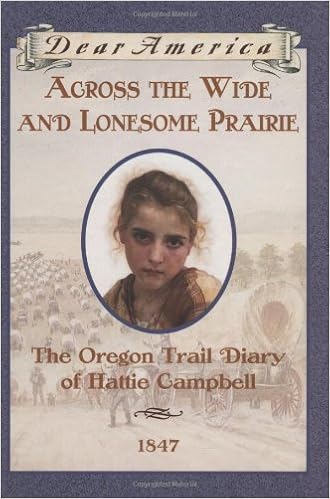
ACROSS THE WIDE AND LONESOME PRAIRIE by KRISTIANA GREGORY : ANCESTRY WORSHIP - GENEALOGY

Image result for across the wide and lonesome prairie
I just came across the DEAR AMERICA series of books, each a diary of a girl, researched by the author, researched and written to be historically correct.  First I thought, "I'll read this book so I can research it for my blog, Ancestry Worship - Genealogy," but I got so into it I forgot to feed the dog.  

Hattie Campbell, the "author" of this one goes with her family on a six month journey to Oregon on the Oregon trail and all around her people are dying, being born, stealing, dancing, marrying (at 14 years old), suffering, hoping and healing. There is much to risk and much to loose. The scenery is beautiful but treacherous. Follow along as the animals give out, people drown crossing rivers, and the wagon train parallels and then briefly joins the Mormons across the country and some decide upon California, fearful that if they don't cross the mountains in time they will end up like the Donner Party - cannibals


C 2019-2025 Ancestry Worship Genealogy - BlogSpot
All Rights Reserved including Internet and International Rights