Showing posts with label Los Angeles. Show all posts

02 November 2025

VISITING THE SECOND OLDEST CEMETERY IN LOS ANGELES : HISTORICAL WILMINGTON CEMETERY : MY THOUGHTS AND FEELINGS AS A GENEALOGIST

I was recently able to visit the second oldest cemetery in Los Angeles, in Wilmington, California which is in the South Bay area not far from the Port of Los Angeles (which is the Ports of San Pedro and Long Beach).

WILMINGTON CEMETERY

People had begun decorating for the Day of the Dead celebration there with marigolds and other flowers and vibrant decorations. There are some fairly recent burials and a good number of them are of Hispanic people, likely Roman Catholic.  Many of these gravestones have images - be they photos or some new etching technology - of the person or the couple - who are buried.  It is my idea that some families are adding their loved ones to graves that have been in the family a while.

But more on the burials in a bit.

This is a flat gravestone cemetery and from the signage I had no idea how large it really is until I got into it. It's a square of land with some old trees not far from the railroad tracks with some of the containers that came on ships to the harbor visible.

It was established in 1857 by Phineas Banning. That means that it was in existence before Phineas Banning built his large house across the way in 1864. There are some very old burials there.

HISTORICAL MARKER DATABASE - WILMINGTON

Excerpt: It is the oldest active graveyard in Los Angeles. Pioneer families buried here include Banning, Carson, and Sepulveda. There are 37 Civil War veterans, and soldiers from the Spanish-American War and from the Normandy D-Day invasion.

***

This is the cemetery used by some of the Bannings who lived in the Banning House. Which is a ten minute walk away in a beautiful well-kept park. 

The Banning family had a number of children who died as babies buried there.  And a wife who died relatively young.  A William Banning has a grave stone that states that he was born in Wilmington, Delaware in 1841 and died in Wilmington, California in 1891. Yes, Wilmington in California was named after the town in Delaware and the Bannings started out as Yankees, which might have everything to do with Phineas siding with the Union for the Civil War.

BANNING HOUSE - THE BANNING MUSEUM 

Excerpt: Phineas Banning—entrepreneur, the founder of the city of Wilmington, and “the Father of the Port of Los Angeles”—built the 23-room residence in 1864. Subsequent generations lived in it until 1925; in 1927 the residence, stagecoach barn, and the surrounding 20 acres of parkland were acquired by the City of Los Angeles.

***

It also not far from the Civil War Barracks which Phineas Banning donated to the Union Army during the Civil War.  DRUM BARRACKS ORG

The Drum Barracks has an archive but my experience with that was that they would prefer you do your research elsewhere since much or all of the archive is duplicated elsewhere.  Information I sent a few years ago was also not acknowledged. 

According to one of the employees of the Wilmington Cemetery, the land there used to be water wells for the merchants during Banning's time.

I spent about an hour walking around the memorials.  It is said that there are over 9000 burials there. Certainly it did not seem so, and there were areas where there were no gravestones at all.
To my reader-genealogy researchers, please remember this is the case with many cemeteries and one should not entirely rely on grave-stone databases. If you suspect or know that an ancestor was buried in a cemetery contact that cemetery for information. It helps if you have the death certificate that states the burial took place there, or a funeral home record.

I did not take photos of any of the graves, which I think of as disrespectful.

One of the most interesting was a small slab that announced the death of a one month old Japanese or Japanese-American baby.  

There is a street in Wilmington called Opp. Opp burials included someone born in 1848 who died in 1906. I imagine they may have had some land - a farm.

There is at least one 'died in Korea' marker, some that indicate World War II took their man, and a couple that indicated that the person had served in a state militia or reserve.  Last Memorial Day (2025) a local boy scout troop provided a memorial with the names of local men who had served their country.

Wouldn't it be wonderful if there were no longer wars on this earth?  (As I told a good friend of mine the other day who said "that won't happen," then I would like to be reincarnated on a better planet.)

The babies and children who died long ago made me think of vaccinations and what a difference they have made. Anyone who has seen the archival documents that reveal the babies and children who died of childhood diseases, the adults who died of TB, and the townsfolk who died of various 'plague' must know that.

Besides Mexican or Hispanic burials there were also some surnames that were Germanic or Italian or English.  I don't often visit cemeteries, but I'm intrigued by the art and design of some stones and try to imagine what ornate ones must have cost when they were made. There were a good number of Masonic symbols on graves in this cemetery.

I like to find not just the oldest burials but burials of those who got a long life out of this one. Here's a little name dropping. LIPKING 1822-1909, COATES died 1914 at 71 years old, OPP 1848-1906.


I have come to hate Halloween for all the gore and horror and fright and violence it now celebrates. We actually do not need to be exposed to more violence or participate in that. I'm into the acknowledgement of those who came before us though.  This is why, though I have no Hispanic or Mexican heritage, I'm more likely to contribute to a celebration such as Day of the Dead.  

Christine

10 February 2025

VISIT THE AFRICAN AMERICAN CULTURAL CENTER in LONG BEACH CALIFORNIA


 AACCLB - African American Cultural Center - Long Beach California

Long Beach is far south in Los Angeles County and far from the fires.  I was able to see this exhibit - small but impressive - and suggest YOU might find it as interesting as I did. The AACCLB has changing exhibits and opportunities to explore.

15 January 2025

JAPANESE FARMER BEFORE EVACUATION - LOS ANGELES COUNTY


source of photograph : Library of Congress - Washington DC - Prints and Photographs Collection
Los Angeles County, California.  The evacuation of Japanese and Japanese-Americans from West Coast areas under United States Army war emergency order.


22 January 2022

A HISTORY OF LABOR LAWS FROM THE UNIVERSITY OF IOWA

LABOR CENTER : UNIVERSITY OF IOWA 

Follow the time line of changes up to 1938 as regional changes occurred addressing unfair labor practices.

*****

Listening to the radio in the wee hours of the mornings recently I learned that Los Angeles has a backlog of 50,000 evictions, that the city of West Hollywood recently upped the minimum wage to be paid there to $17 an hour, and that half of all American households cannot afford to buy or run a used car...

We Are Living Through History.  Be sure to write your memoirs!

19 March 2019

SAINT PATRICK'S DAY - A DINNER WITH ONE ONE HALF IRISH PERSON : IRISH GENEALOGY

Since American genealogy often includes Irish ancestry, because we supposedly all have "a wee bit" of Irish in us, I asked at the Saint Patty's dinner I attended who actually had some Irish.  

As it turned out, only one person in 25 there had some.  He was half Irish and Catholic and half English Protestant. We elected the one "Irishman" there to do a jig for us.  He camped it but said actually he was first an American and second an Angeleno (from Los Angeles).

Still, everyone enthusiastically ate their corned beef and cabbage, which included some perfectly uniformly round potatoes and perfectly uniformly sized baby carrots; I suspect these days big potatoes and carrots are put into machines to create these shapes and sizes.  


How attached to ethnicity any American is is up to debate but I generally see that immigrant Americans define themselves by the country or ethnicity they left behind, first generation refers to this also, but by the second or third generation memories of old country and old ways have diminished significantly. Recipes and eating habits are brought forward.

As for Irish-American genealogy, the practice follows the usual paths until one can jump across the ocean and deal with the archives of Europe, in particular church records. Common surnames confound as usual.

I was able to tell one Native American person at the dinner about the "grass eaters," the Irish starving because of the Potato famine who ate grass until their mouth area was tinted green. I told about the exploitation Irish immigrants experienced on the ships where conditions could be filthy. The immigrants were expected to scrub the ship and clean up before coming into port. Many of the "grass eaters" were skeletal when they boarded and some died before they got to America. From the potato famine immigration generation, came the ancestors of President John Fitzgerald Kennedy.

If you're doing Irish-American genealogy, you may go back before steamships. I feel that finding Naturalization papers should come before finding ship information as it should mention the name of the ship and possibly place of birth or place left in Ireland. This sometimes helps when dealing with common surnames. Be aware that some Irish left their homes and first found work closer to ports in order to buy their tickets - or eat enough to be healthy when they boarded. The place they lived temporarily may not be their place of origin but is listed on the ship manifest.  Sometimes a World War I draft registration can be a better informational source for villages of birth or origin.

C 2019 Ancestry Worship Genealogy
This post has been edited with more information given July 2019.

29 May 2017

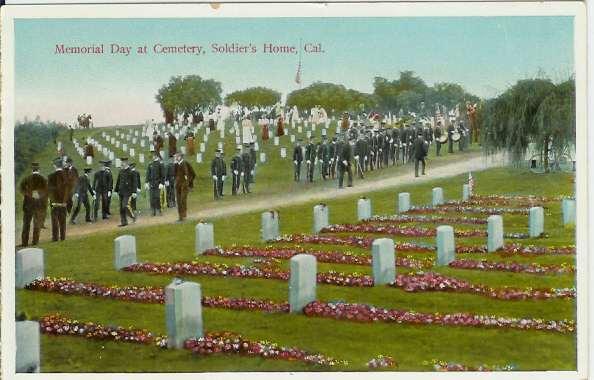
MEMORIAL DAY - OLD SOLDIERS HOME - LOS ANGELES

I believe this old postcard is of the cemetery in Los Angeles
associated with the Veteran's Administration Hospital. 
There's no more room in it.
Recent VA burials are minimalistic and the body is taken into another county.
So genealogically, the person might have a Los Angeles County death certificate but not a Los Angeles County burial.
If you're driving on the 405 Freeway you can see the stiff rows of identical tombstones, standing, yes, a bit like soldiers at attention.
As far as I know the Soldier's home is abandoned but on the property. Since there are so many homeless veterans in the area, there's talk of tearing it down - who needs another historical site when modern housing is needed?


10 September 2012

JEWISH HOMEGROWN HISTORY AT THE SKIRBALL CULTURAL CENTER : WHY HOMEMADE MOVIES BECOME A PART OF CULTURAL HISTORY

Back in the spring I attended an exhibit at the Skirball Cultural Center in Los Angeles called JEWISH HOMEGROWN HISTORY. The USC Casden Institute for the study of the Jewish role in American Life and the USC School of Cinematic Arts were behind the presentation and panel discussion.

A gallery of the center was used to project a series of home movies. taken by families of families and covering various rites of passage as well as everyday life. Most of us have had the experience of being asked to watch a home movie (or maybe one that was taken of a wedding or other family event by a professional) and feeling a little bored with it, especially when it's something that's been shown more than once. The quality of home movies varies, and in the early days of home movies, the stars did a lot of waving to the camera. These home movies are related to the reality TV shows of today though and I think are more interesting the more time has passed.

That's because Home Movies are time capsules. We get to know a lot about the stars - the family - by observing their clothing, hairstyles, and the places they lived and held ceremonies and celebrations. We can tell something about what they thought to be important, what they spent money on film and developing on. We can see them alive and moving, rather than posing for a picture.

HOME MOVIES can be an important preservation of family history, and whatever your family ethnic or religious culture, part of preserving memories of that culture.

C 2012-2025 Ancestry Worship Genealogy. All Rights Reserved including Internet and International Rights