Showing posts with label England. Show all posts

23 December 2025

THROUGH LUCY'S LENSE YOUTUBE STATION : A SOCIAL HISTORIAN TAKES US THROUGH HOUSING FOR THE POOR IN BIRMINGHAM


I love this video and social historian Lucy's work so I'm adding this to my list of YouTube station recommends.  You can bring past posts in this series by clicking on that label below.  Go to her channel to find more fascinating videos!


Excerpt from this station : 
Using the houses as they are displayed today, including the preserved “time capsule” area, this film looks at everyday Christmas life in working households during the 1840s, 1870s, and 1930s. Rather than focusing on tradition or nostalgia, it examines how Christmas fitted into ordinary routines shaped by work, housing conditions, health, overcrowding, and limited income. ... Back-to-back houses were once common in industrial cities across Britain. While examples still exist in places such as Leeds and Bradford, most were demolished during twentieth-century slum clearances. The Birmingham Back to Backs are a rare preserved group that allows visitors to step inside and understand how these homes functioned as lived spaces over time.

Posts like this one can be found by clicking on the label YouTube Station Recommend

C 2026 Ancestry Worship - Genealogy BlogSpot

25 October 2025

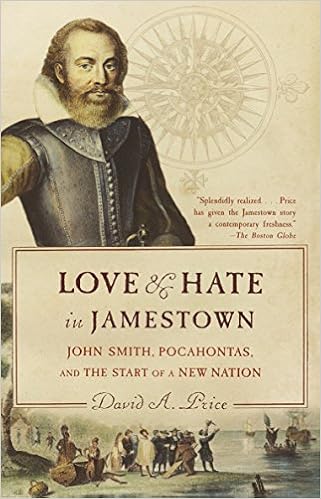
LOVE and HATE IN JAMESTOWN by DAVID A. PRICE: ANCESTRY WORSHIP BOOK REVIEW

Image result for Love and Hate in Jamestown
LOVE and HATE IN JAMESTOWN by DAVID A. PRICE: ANCESTRY WORSHIP BOOK REVIEW (First published on this blog on February 9, 2019)

PROMISED to clear away the misconceptions and half truths, let's start with that explorer Captain John Smith never had a romance with Pocahontas, who was about 11 years old when she first saved his life. She was the favorite of Powhatan, the "King" of a great Native American Nation, one of his children by his many wives. For those of you who may be seeking ancestry connected to Powhatan, consider that he'd take a wife and discard her after she had a child by him, which sounds like a strategy to spread you genes to me. (In European Feudal times the Lord of the Manner, or the owner of the Estate, sometimes also had rights to have sex with a woman before she married another subject.) Captain Smith was appreciative, after all the maiden saved his life twice, but if she had a thing for him, he considered it a platonic relationship. Smith was never in his 40 years or so of life known to have a romantic relationship with any woman.  

In 1607 the first three ships, all quite tiny really, landed in Virginia with an attempt to colonize. (The Spanish considered this part of the country to be theirs and recognized "French America." The British were far behind in their attempts to colonize.) In 1608 a second supply of colonists arrived including the first woman, the wife of a gentleman, and her maid. With 200 men to this one unmarried maid, well, she was soon married. Speaking of the gentleman class - the leisure class - of passengers, they apparently expected to have adventures but not to have to work. But not for long. Captain Smith basically ruled that if you did not work, you did not eat.

Captain John Smith had military experience, having been in warfare in Hungary, but he was not expected to rule the colonies. Deaths in the colony allowed him to rise to the task and he did so well. Considering that he and the Englishmen had to try and understand the Native American culture they encountered, he showed patience and cunning. Smith knew how to bluff and so the starvation of the colonists was at best delayed.

In this book, you'll read about the relationships between the English and Native Americans, what worked and what did not. Smith was set aside when the "real" leaders arrived and that's when the bloodshed began. 

Pocahontas was converted to Christianity, married an Englishman and gave birth to the first Native-American/ English child. She traveled to England and was introduced to society as a woman of rank but she didn't live long. She had been told John Smith had died. When she saw him in England she was not amused.

Also of interest, besides Hungary being a training ground for Smith, is that some Germans and Poles came to be craftsmen, to make of glass for an example, in the New World. Thus central Europe and Europeans are part of this story.

Finally, yes there was cannibalism.

C 2019 - 2025 Ancestry Worship Genealogy - All Rights Reserved including Internet and International Rights.  This post has been slightly edited July 2019

29 March 2025

BIOGRAPHY and THE WRITING OF YOUR FAMILY HISTORY : HERE'S AN INSPIRING EXAMPLE

I was attracted to this book at the library, England's Mistress - the Infamous Life of Emma Hamilton, by Kate Williams, because of its lovely cover. I've read many biographies and memoirs. This impressive one is about a person born in poverty, the lowest of the low, who managed to make it through the ridged English class system and become the wife of Sir William Hamilton. Born Amy Lyon, this woman went from being an orphan to working as a child laborer, from prostitute to mistress to wife. She also became an actress and singer, and was imitated as a force in fashion back in the day. She became the personal friend of a Queen or two. She was exceptional by beauty but also seized every opportunity to educate and improve herself. I think it's one of the most wonderfully written biographies I've encountered. But why?  Because the research and writing brought forth the realities of life in England - as well as Naples (Italy) - in the late1800's.

I present it here because I want to remind my readers to seek out biographies of their ancestors. They probably do not have whole books written about them hundreds of years after their deaths. However, you may find that a person is included in a local biography, a town book (like a yearbook created by a proud town about their pioneers and citizens), newspaper articles, and such. There are still many books on library shelves that have not been digitalized - not scooped up by the big names in genealogy databases.

But also, in writing your family history, in putting a person in their life timeline, you may want to also explain their times - the history of the place they lived - and what it was perhaps like for your ancestor to live in them. 

You of course quote and attribute the passages you use in your work.

Here are some excerpt examples from the book that are excellent.

From page 5, year 1764, in a small village just outside Chester across the Dee River.

Emma's parents were married on June 11, 1764, in Great Neston church. As the wedding was held on a Monday, it is unlikely that any relative...attended.  Like many workingmen, Henry was illiterate and signed the register with an X, Mary also signed with a cross....  First babies were often conceived outside of wedlock; indeed, many communities encouraged it to preclude the disaster or marriage to an infertile wife. .... At twenty-one, Mary was a drudge in a dirty hovel, her day consumed by domestic chores, in a village populated by people who were, in the 1850's according to visitors, "as primitive as their village was secluded."  At four she awoke to fetch water, light the fire, and prepare Henry's breakfast... After he left at five, she began her daily battle against the dirt that silted up the windows and covered every surface with a grimy film. (Coal dust) Outside her window lay a treeless expanse of  scrub scarred by heaps of coal waste, and cheap stone cottages blacked by sooty rain. She knew that soon after she gave birth, she would be expected to work in the mine with the other women.

WHAT DAY OF THE WEEK WAS THE MARRIAGE OF YOUR ANCESTOR HELD? WHAT MONTH? 

Excerpt page 6 : Emma was baptized on May 12. On the register, her name looks like 'Emy" but Emma herself always claimed it was Amy. a common name in the Kidd family. ... One in three children like Emma died within infancy, but she was born in the best season for survival; disease was more virulent from June to September, and babies died of cold from November to February. There was hard work ahead for the infants who lived. Denhall employed most children over nine or ten as cheap labor. All the girls born in Ness were, by the age of ten, pulling baskets to the surface every day, covered in dirt and regularly harassed by the men.  At the end of the day, they returned home to cook and clean for their family or, as was near as likely, since many women died in childbirth, stepmother.

WAS YOUR ANCESTOR EMPLOYED IN COAL MINING?  A CHILD LABORER? 

Excerpts such as these, when appropriate, add color to your family history book, but also give the reader an opportunity for understanding.

C 2025 Ancestry Worship - Genealogy BlogSpot  All Rights including Internet and International Rights claimed.


03 December 2024

NATIONAL ARCHIVES OF THE UNITED KINGDOM : AN IMPORTANT AND EXPANSIVE ARCHIVE BUT A BIT DIFFICULT TO NAVIGATE

NATIONAL ARCHIVES UNITED KINGDOM start page

OK I find this particular on-line catalog a bit difficult. The United States National Archives also was and in recent times was reworked to make it a tad bit easier.

So the first search I used was the word GENEALOGY. Here's where we go:

NATIONAL ARCHIVES UNITED KINGDOM WORD SEARCH GENEALOGY RESULTS

image from Wikipedia

Though some of the listings that come up still are not quite what we are looking for, we're getting there. I'm going to excerpt from the listings involving Catholics and why this is important to genealogy research:

Excerpt: 1 WHY USE THIS GUIDE?

Until 1534, England was a Catholic country. Then, after years of upheaval, the 1559 Act of Supremacy made the Protestant Church of England the established church. Following this act there was a significant increase in the number of state records created documenting Catholics’ status and activities, subject as they were to new laws, taxes and a wave of persecution. The primary focus of this guide is on those records, especially from the 16th and 17th centuries, and how to find them at The National Archives. They include:

records of penalties and punishments

details of arrests

letters from private citizens and spies sent to the authorities

reports on Catholics sent by ecclesiastical and civil authorities

baptism, marriage and burial registers

By the 18th century Catholics were no longer persecuted, but were still effectively barred from entering the professions, holding civil or military office, or inheriting land. Formal emancipation finally came in 1829 and state records relating to Catholics exists in smaller numbers from this date onwards.

Like all churches, Catholic churches kept their own records, though very few of these, in common with most local or parish church records, have found their way into The National Archives.

*** That's my italics, emphasizing that records for Catholics will still be found by finding the dioceses ...

I ENCOURAGE YOU TO GET INTO THIS CATALOG IF YOU ARE RESEARCHING ROOTS OF YOUR AMERICAN, CANADIAN, AUSTRALIAN, IRISH, WELSH, or SCOTTISH ANCESTORS!

C 2024 Ancestry Worship - Genealogy BlogSpot All Rights Reserved including Internet and International Rights

17 August 2024

MARTHA AND MARIA JEFFERSON ATTEND AN ELITE CATHOLIC GIRLS SCHOOL IN PARIS - THE PANTHEMONT - CISTERCIAN SISTERS


Of great interest to me also was that Jefferson's daughter Martha (the oldest), who went to Paris with him when he represented the United States there, was of Protestant heritage, but went to the most elite Catholic private school for girls, run by nuns. To me this means that Jefferson was not only doing in Paris what a wealthy Parisian might, being in that culture, but that he cared that his daughter have a good education. At one point she was tempted to join the nunnery.  There were other Protestant girls who attended there, including some from England,  The school was called Panthemont.  the Convent School was run by The Abbess, Catherine de Bethisy de Mezieres from 1743-1790. These schools often only taught what was considered necessary to turn out a fine young woman, and the students did not often stay for long, so you might think of them as "finishing" schools.  

Page 44 : "Although some had begun to argue that women also possessed intellectual ability and the capacity for rational thought, pragmatic parents had to groom their daughters for the marriage market that still abhorred the femme savante, a disparaging term for the woman who made herself ridiculous by proudly displaying her learning. 

The dismal state of female education in Paris could also be explained by the short amount of time girls actually spent in formal learning: one study of seven Paris convent schools found that 60 percent of the students attended for less than two years. By 1800, only 27% if French brides could sign their names in the marriage registers, as opposed to 40 % of the English ones

(This book has quite a list of the various books Martha Jefferson was required to read in French literature, books that taught the value of work, the dangers of flattery, and the rarity of true friendship. She was also taught to write letters as a n art. Besides embroidery and needlework, drawing and painting flowers, and so on, the girls learned history, some arithmetic, and geography.  While critics said that female students were just given a bit of understanding of these subjects often reserved just for men, the nuns and the students took their education seriously.  I would also like to mention that there seems to have been an influx of girls being readied for the marriage market and that there might not have been an emphasis of a graduation or completion of studies.)

Page 22: (In particular to Martha's daughter Ellen Randolph...) Ellen considered herself a "bluestocking" that is an elite female thinker. But such women were not sought out as wives. Ellen wrote that her experience, north or south, a woman who 'is believed to have received a useful education is really more welcome than a blue stocking Unitarian democrat.' 

Notes: as Martha's husband Tom Randolph went into more debt, unable to sell property, and taking more bank loans, it became clear that the daughters would not have dowries and there was a concern that they would have to marry well. His financial problems made it impossible for him to provide them with dowries large enough to attract the husbands they would need for their own financial stability.

C 2024  Ancestry Worship - Genealogy Blogspot

24 June 2023

THE ANCESTRY OF PRESIDENT GEORGE WASHINGTON


A chart from the Library of Congress that includes the English Heraldry of the Washington family.  I'm always interested in the artistic notions that various family trees, records, and other documents reveal.  These historical renderings can inspire us to think about ways we can fashion our own ancestral charts.

25 June 2022

TEXTUS ROFFENSIS - PRE MAGNA CARTA ENGLISH LAW MANUSCRIPT - UNESCO's UK Memory of the World Register

I was going to link to the article in DailyMail Online about this, but for whatever reason it's not working.  

So, to reiterate, Rochester Cathedral is the second oldest in England (first called Saint Andrews and built about 604) and that is where the manuscript is kept. It is in old English. Called Textus Roffensis, it predates the 1215 Magna Carta and was a compilation of laws that go back before the Norman Conquest. Monks at the Saint Andrew's Priory at Rochester Cathedral likely created this illuminated manuscript. One of the reasons the monks may have created it is that at the time England was not unified and, for instance, there was a King who ruled Kent.  So, I see that if one were traveling from one Kingdom to another, one might want to know the various rules and regulations for each before hand.)

A little research on this cathedral and it is and has all along been a parish in which services are conducted. Because of its historical nature, there are also exhibits...

https://www.rochestercathedral.org/exhibitions

1400 years of prayer!


07 November 2021

1921 GREAT BRITAIN CENSUS - 38 MILLION PEOPLE IN ENGLAND AND WALES and SCOTLAND COUNTED

 This census is officially open and out of the privacy acts that effect release.  However, like other census the information will not be instantly digitalized and ready for viewing.  This site will keep you updated as you need to be.  It will be available on January 6. 2022 on FINDMYPAST.

1921 CENSUS ORG

Excerpt: This site concentrated on the 1921 Census for England, Wales, and Scotland, whcih was taken on the night of Sunday 19th June 1921.

However, there is information on other censuses which were taken the same year sinc an attempt was made to take a census as far as possible THROUGHOUT THE EMPIRE, for example in Australia, Canada, India, New Zealand and South Africa.

This site concentrates on the 1921 Census for England, Wales and Scotland which was taken on the night of Sunday 19th June 1921.

However there is information on other censuses which were taken the same year since an attempt was made to take a census as far as possible throughout the Empire, for example in Australia, Canada, India, New Zealand and South Africa.

There is also more on the census that should have been taken but wasn't, the 1921 Census of Ireland.

If you are interested in other United Kingdom censuses from 1881 through to 1931 as well as the information gathered in 1939 for the National Identity Card, there are more details on our sister site 1911census.org.uk.

17 August 2021

WORLD WAR II BRIDES IMMIGRATED TO CANADA - A HISTORY OF IMMIGRATION POLICY

PIER 21/IMMIGRATION WORLD WAR II BRIDES CANADA  A detailed article that might help you.

EXCERPT:  Before the Canadian government amended its immigration policy to provide a humanitarian response to the European displaced person and political refugee crisis, it focus its attention on the resettlement of soldier's dependents.  The resettlement of war brides and their children from 1942 to 1948 marked the first time that the federal government provided a "home to home: service.

EXCERPT: According to the Department of National Defense (DND) approximately 48,000 marriage with 22,000 childbirths were known to have occurred between 1942-1946.  In all, 44,886 (93%) of these unions involved British women, followed by 1,886 (4 percent) with Dutch women, while 649 (1 percent) were with Belgian women.  These marriages were not limited to the British Isles or northwest Europe and included 362 marriages with women of other nationalities (see Table 1).  Approximately 97 percent of all births resulting from these marriages were born to British women.


03 November 2018

COATS OF ARMS and ROYAL BASTARDY : ANCESTRY WORSHIP GENEALOGY BOOK EXCERPT AND REVIEW

According to Cecil-Humphery-Smith, in the book ROYAL BASTARDS, the coats of arms of bastards, which first appeared for the children of King Henry I, are different than for children born within the marriage of the royal personage. Some of these children were given land and titles but it wasn't until the Tudors and Stuarts that they were given titles of nobility and peerage.


"Often, the identity of the putative father can be discovered from the names given by the mother at baptism or registration."  Suggested is that if the mother is named Mary Smith and names her child Bill Harrison Smith, then look for a Harrison or Bill Harrison in the records.

Another way that mothers of illegitimate children named them was by the PLACE of BIRTH.

The word Fitz as in FitzJames is an indication that the father himself is recognizing the child but the child will not carry his surname.  His or her surname indicates the father's first or last name is James.

*****

I've noticed in my own research in another country in Europe that over a couple hundred years time it seemed very few children were illegitimate in the church records.  But when a child was, it seemed they were given a name uncommon or exotic for the common, often repetitive, naming patterns of the others in the church.

There was one woman in the church records I read who had very many illegitimate children.  She must have been so poor for her children died early and often. What a terrible life she had and yet she wanted it. I have so wondered about this woman. Was she the one and only town prostitute?  Did one man after another take advantage of her? Was she in love with a married man? Was she an orphan? Was she perhaps slow?  I see that the priest baptized her children.  And I see that when she managed to live past the age of 40 a widowed man married her.  Did he just need someone to cook and clean?  Or was he the father of all those children?

C 2018-2025 Book Review by Ancestry Worship Genealogy

16 May 2018

STOLEN GENEALOGIES - THEFTS THWART INHERITANCES

These days there are so many opportunities for people to play at genealogy and share information (proven or not) that the answer to the question of what information is stolen is rather fuzzy.  But in this post I consider genealogies that were actually physically stolen!


It just so happens that over the last couple months I've run into two couples who are upset because the genealogy of their family was stolen along with other items from their garages!  OK, a typical garage is NOT the place to keep a family genealogy.  I believe that it should remain in a house that isn't damp or filled with insects or rodents or the gas fumes and if you inherit some old paperwork, it deserves to be copied.  Consider taking it to a place that does big blueprint copies for architects and designers.  Then put it into a mailing tube and seal that up.  Consider putting copies into the archive of a library or to be held in another family member's dehumidified attic.  Do something to preserve it!  (And remember to go over it and proof everything yourself, just in case someone in your family was too eager to tie you into royalty or casino rights!)


In the cases I recently heard of though, INHERITANCES were being tied up because someone died without a will or or had a will but did not have the names and addresses of those family who were to inherit.  One of these cases takes place in the United States and the other in England.


To begin with the English case, the American family contracted with some company over there YEARS ago to track down those due to inherit.  I'm sorry to say I believe that this company did nothing or is claiming to be doing something but hasn't or this couple have been uniformed because they were cut out. I suggested they get with the company and find out what is going on.  If you are in the United States and in this situation, and there is a nice sum of money you need possibly waiting for you to claim, be aware that you do not need to hire some person or company in England to do the work.  Granted it's possible that a judge in a court there might find a local company rather than a distant one more believable but not necessarily.  First of all records for England are usually quite good, it's a small country, and a professional there should know the resources and how to get to them quickly.  After all, the person who died only died five years ago.  So I think, just to show that you are not passively waiting or entirely ignorant, you should hire a genealogist who can contact those resources long distance.  (There is always e-mail.)
As for the American family, the person died just a couple years ago with a hand-written will, referring to certain members of the family who he had no contact with for many years, and the effort is a little closer to hiring a private investigator than a genealogist.  Let's just say that I've done PI type work but using genealogy methods as well as genealogy ethics and standards - no schemes, no tricks, no lies (not that all PI's operate this way but some surely do!)  The genealogist verifies the relationship to the person who has died, such as sibling, half sibling, step sibling, third cousin, Great Aunt, and can often locate these deserving people though typical public databases.
I believe that good old snail mail is the best method for introducing yourself and requesting additional information to be submitted to courts, such as official ID's.  Because there is so much identity theft, some people usually do need assurances that the genealogist is working for the benefit of a court or legal representative.
C 2018 Ancestry Worship Genealogy  All Rights Reserved.

17 May 2016

THE 1939 REGISTRY - SPECIAL PRE WORLD WAR II CENSUS TAKEN IN ENGLAND AND WALES

THE GUARDIAN - 1939 REGISTRY - A TALE OF A COUNTRY ON THE EVE OF WORLD WAR  A SPECIAL CENSUS CONDUCTED in ENGLAND AND WALES before people started fleeing the bombings to the country or wherever!

EXCERPTS:

The population register, taken in late September 1939, just after after the outbreak of the second world war, is the only surviving record of the population of England and Wales between 1921 and 1951. The digital version was released on Monday by Findmypast in association with the National Archives.

The register, compiled by 65,000 enumerators and sent to every household in England and Wales, documents the lives of 41 million people. It gives the names of the inhabitants at each address, their date of birth, marital status and occupation.

...

The population register, taken in late September 1939, just after after the outbreak of the second world war, is the only surviving record of the population of England and Wales between 1921 and 1951. The digital version was released on Monday by Findmypast in association with the National Archives.  (In Great Britain not the U.S.)

The register, compiled by 65,000 enumerators and sent to every household in England and Wales, documents the lives of 41 million people. It gives the names of the inhabitants at each address, their date of birth, marital status and occupation.

18 January 2014

WHAT ARE THE ODDS? FOUR CHILDREN BORN SAME DAY - DIFFERENT YEARS

YAHOO - BRITISH FAMILY HAS FOUR CHILDREN BORN SAME DAY - DIFFERENT YEARS

"Sam was two weeks late, the twins one month early and Ryan three days late," Scrugham said.

The family celebrated their older children's birthdays this year with two cakes, one for Sam and one for the twins, and say they plan to continue to celebrate their kids' coincidental birthdays both "individually and together."